Rhopalomyia solidaginis (Loew, 1862)
the bunch gallA gall midge. A fly, despite the name
Not a swelling but an arrest. The midge stops the stem growing upward, and the leaves that would have spaced themselves along it all arrive at once.
The larva takes the apical bud and upward extension stops. Leaves continue to be produced, but with no stem to distribute them they stack into a dense rosette three to five centimetres across, a green flower made of leaves.5 Growth often resumes from a lateral bud, so a bunch gall is frequently found partway up a stem with a sharp kink beside it, not at the top.
It is bivoltine, and its two galls do not resemble each other. The spring gall, in April and May, is so slight you would not know to look: the apical leaves of a galled shoot splay a little, the base they spring from thickens a little, and the shoot may end up shorter than its neighbours. Inside is one conical white chamber about three millimetres long, with a single larva at the bottom of it, head down. Around the chamber stand roughly ten leaves too short and too thin, and on S. altissima those leaves are paler along the midrib. Around those is a whorl of leaves of perfectly normal size, which is why nobody notices.5
The summer gall is the one everybody knows. It appears about mid-June and has reached full size by July, while the larvae inside it are still first instars small enough to sit at the bases of the leaves. The white chambers do not form until mid-July, when the larvae moult into third instars. Each chamber is wrapped in a group of very short narrow leaves, and that bundle is wrapped again in longer wider ones, making a distinct subunit; two to five subunits clump at the shoot apex into the rosette, three to five centimetres across.5 Pupation is in early September and the adults are out in September and early October.
On the ground the quickest check is the host stem. This gall's three goldenrods — S. altissima, S. canadensis and S. rugosa — all carry hairs on the stem at mid-height, where the near-identical rosette of R. capitata sits on smooth-stemmed S. gigantea; look below the flowering branches, since almost every goldenrod is hairy up among the flowers.4
One of the three hosts no longer settles it. A single-chambered rosette gall on S. rugosa was reared in 2024 and produced R. capitata, not this midge, so a bunch gall on rough-stemmed goldenrod can no longer be put to a species from a photograph.304
The two generations are not quite the same animal to look at. Spring adults are smaller and carry fewer antennal segments than summer ones, seventeen against twenty or more, though a specialist would still key them to the same species.5
Where the insect spends the winter is settled. The larvae that raise the spring galls hatch from eggs in the autumn and overwinter inside the rhizomes. The evidence is a greenhouse: rhizome sections cut in the field and planted indoors threw up galled sprouts without ever having met an adult.5 The podcast's show notes said the same thing: autumn larvae going down into the rhizomes, a second brood raising the visible rosettes from mid-June, and were right on both counts.1
One qualification the revision makes about itself. It names this species and R. capitata as the only two whose rhizome overwintering has been directly verified, then describes the evidence for this one as circumstantial, resting on those greenhouse sprouts and a personal communication. Both statements are in the same paper. Nobody has watched the larvae go down.5
The rosette is dense, persistent and structurally complex, and it houses insects that could not otherwise live on that stem. More than one source calls the species an ecosystem engineer, in the sense a beaver is one.2 Its own larvae are heavily attacked by gregarious endoparasitoids, wasps that lay many eggs into a single host, so that what leaves the chamber is a crowd rather than a midge.5
What this gall costs the plant is not fixed; it moves with the weather. A Michigan experiment crossed drought and warming with R. solidaginis galling on tall goldenrod: in ambient conditions galled plants grew about seven centimetres shorter than ungalled ones, but under warming that height penalty vanished. Drought pushed the other way, dropping the chance a galled plant set seed to below one in two, the lowest of any treatment.38
This species has swallowed two others. Felt described Rhopalomyia albipennis in 1908 from the same kind of rosette on the same plant, separating it in part on the male's whitish wings, against the brownish wings of R. solidaginis. When the 2009 revision put Felt's slide-mounted male under a lens, the wing turned out to be covered in fungal mycelium. The whiteness was mould. R. albipennis and R. carolina, described from a single female at Asheville the same year, are both now synonyms of this insect.5
Loew's original pair, collected by Osten Sacken in Washington DC one August in the 1860s, cannot be found in either museum that should hold them. The revision designates a new name-bearing specimen, a male reared from a rosette on S. altissima at West Dryden, New York, in May 1987, so that the name has something physical under it again.5
One further oddity: broods are reported to be single-sex: one female's offspring all male, another's all female. No adaptive explanation has been established.
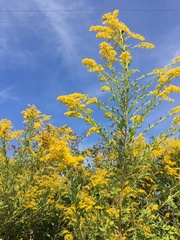 S. altissima
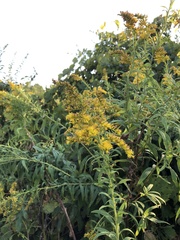 S. canadensis
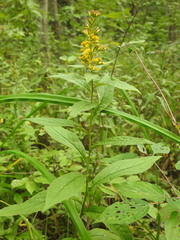 S. rugosa