Rhopalomyia capitata Felt, 1908
the giant bunch gallA gall midge. A fly, despite the name
The bunch gall's larger cousin, and a reminder that most of what hatches out of a gall is not what made it.
A large terminal leaf cluster, bivoltine like R. solidaginis. The revision is firm that the two are separated by host as well as by anatomy: this one on S. gigantea, its cousin on S. altissima, consistently.5 A 1994 survey found these galls on S. leavenworthii too and filed them under the wrong midge; molecular work in 2005 put those specimens back inside this species.5 The catalogue also carries records from S. canadensis and S. rugosa, which the 2009 revision did not endorse; the rugosa record gained direct support in 2024, when this midge was reared from a single-chambered rosette gall on rough-stemmed goldenrod, an atypical gall quite unlike its usual leafy mass.230
Its spring generation was described for the first time in the 2009 revision, and the winter came with it: the larvae hatch in autumn and overwinter as first instars inside the rhizomes, deforming nothing while they are down there. It was found the same way as in R. solidaginis: rhizomes dug, cut and planted in a greenhouse in very early spring produced galled sprouts that had never been near an adult. The spring galls appear on young S. gigantea shoots in early to mid May, close to the ground and easily mistaken for Dasineura folliculi.5
The spring gall is worth knowing because it is findable and almost nobody looks for it. It sits on young S. gigantea sprouts in early to mid May, close enough to the ground that you have to crouch. One to eight white conical chambers stand among a mass of short narrow leaves, each with a single orange larva; that central complex is about three centimetres across and is ringed by five to ten much longer, wider leaves, which makes the whole thing star-shaped and as much as ten centimetres wide. Early on, the long outer leaves sheath the middle tightly and only loosen later.5
Its near neighbour on the same plant at the same moment is the gall of Dasineura folliculi, and the two are genuinely easy to confuse. The test is the centre: Dasineura never packs multiple short leaves there, building instead from several similar leaves that are broader and thicker at the base, and it leaves yellowish spots on the foliage below and around the gall.528
The summer gall is what most people find. It is apparent from about mid-June, varies enormously in size, and is built of several broad leaves wrapped round dozens of densely packed short ones, a little sunflower, flatter than the rosette of R. solidaginis. Sometimes the outer leaves fuse into a continuous sheath. Six to twenty white conical chambers, four to six millimetres tall and one to two wide, appear only when the larvae reach their third instar, and they sit together among the short central leaves rather than each having its own wrapping of longer ones. That is the reliable way to tell the two rosettes apart with a knife.5
Its larvae are heavily attacked by polyembryonic endoparasitoids, wasps whose single egg divides into many genetically identical larvae inside the host, and parasitism reaches 90% at some sites in some years. Ectoparasitoids work the same galls, feeding on the midge's larvae and on its pupae.5 Rearing the midge itself is correspondingly difficult, because what emerges is usually something else.
A goldenrod shoot tip can be taken by this midge and by Dasineura folliculi at the same time, and the result is a gall wearing both signatures at once: feeding spots on the outer leaves from the cecidomyiid that makes them, and a tuft of shortened leaves at the centre from this one.5
Felt described a further midge, Rhopalomyia inquisitor, from a single male and a single female, and later speculated that it lived as an inquiline inside R. capitata galls. The 2009 revision looked and found no sign of it there, suggesting instead that it induces inconspicuous conical galls on leaves that Felt simply missed.5 Galls within galls are real: on rabbitbrush, a Rhopalomyia builds its own gall inside a fruit fly's.26 On goldenrod, nobody has shown it.
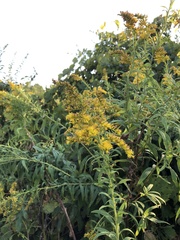 S. canadensis
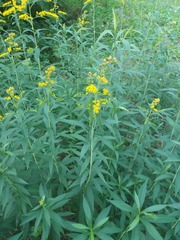 S. gigantea
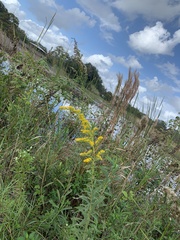 S. leavenworthii
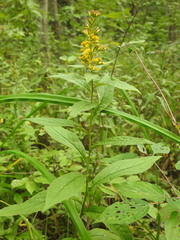 S. rugosa