Eutreta novaeboracensis (Fitch, 1855)
the rhizome gallA fruit fly, the picture-winged kind, not the kitchen kind
Below the soil line, on the underground stems, where the field guide runs out.
A tephritid that tunnels and galls the rhizome, the horizontal underground stem in which goldenrod stores its reserves and from which next year's shoots arise.40
Probably oligophagous, attacking the rhizomes of S. altissima and occasionally other goldenrods, which follows the usual pattern for gall-forming Tephritidae.40 Records here are from S. canadensis and S. rugosa.2
It has over sixteen hundred observations, which makes it commoner than most galls here. Almost none of those observations were made by someone walking through a meadow. You do not find this one; you dig for it, or you turn over a root mass by accident.
It is not alone down here. Rhopalomyia thompsoni also runs both of its generations in the rhizomes: the spring galls are bulbous fleshy masses with up to eight chambers that push above the soil and split open before the adults leave in early May; the second generation is a brownish, usually many-chambered swelling still entirely underground in mid-August, holding mature larvae. It pupates in late August, at which point the gall lengthens and turns fleshy, and shortly before the adults leave it too surfaces. They emerge in the second half of September.5
That midge also carries an unresolved question of the kind this compartment produces. Felt named S. rugosa as its host in 1907 and S. juncea in 1915. The 2009 revision looked for spring galls on both and found none, concluded the host is really S. altissima, and offered the obvious explanation: telling goldenrods apart in early spring, before they flower, is genuinely hard, and the original identification was probably wrong. The authors say outright that confirming this means finding spring galls and checking the plant they came out of, which nobody has yet done.5
A misidentified goldenrod is the recurring failure in this whole subject: the podcast's hosts talked themselves into one over a rough-stemmed plant carrying a ball gall; it separates a real host record from a catalogue entry; and here it is again in a taxonomic revision, unresolved, ninety years after the fact.
Six of the gall forms in this guide live below ground. It is the least-observed compartment of the system, and there is no reason to think it is the least populated.
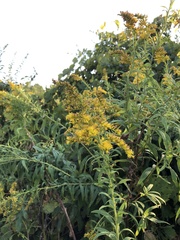 S. canadensis
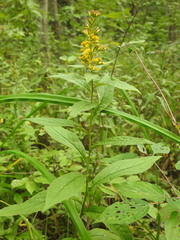 S. rugosa