Procecidochares atra (Loew, 1873)
A fruit fly, the picture-winged kind, not the kitchen kind
A second fruit fly on goldenrod, far less famous than the first, nearly as easy to find, and hiding what may be more than one species.
It is one of the largest and most frequently collected fruit flies in the eastern United States, running from Florida to Nova Scotia and west to Utah and Idaho, and it raises a rosette of swollen tissue wrapped in leaves at a shoot tip.41 With more than three thousand observations it is the fourth-commonest goldenrod gall on the continent, and almost nobody who knows the ball gall knows this one.
Its two generations are often said to build structurally different galls. The one paper on the subject says otherwise. Spring and late-summer galls are both swollen tissue in a leafy rosette; what differs is where they sit and how many animals are inside.41
A rosette on a shoot tip can also be the work of one of the leafy midge galls, and in the field the tell is the centre. The leaves of a Procecidochares rosette do not taper to a thin point in the middle, and the middle usually shows a semi-open cavity rather than a small enclosed chamber. Where several rosettes cluster on one shoot, at most one caps the very tip; the rest sit below it and point outward.4
The spring galls sit two to four inches off the ground on the apical meristem, and they are crowded. Three that were dissected held fourteen, twenty-one and eleven larvae, an average of just over fifteen, developing gregariously in one shared space with no partitions between them. The previous maximum recorded anywhere in the genus was thirteen. Every published account of this fly until then had described it as monothalamous, one larva to a gall.41
The late-summer galls are placed differently, midway up the stalk or higher, and every one collected held a single puparium. So the same fly, on the same plant, packs fifteen larvae into a gall in May and one into a gall in September. The authors say plainly that they do not know why.41
They also raise the possibility that it is not the same fly. Most Procecidochares use few hosts, and where a species is credited with many, cryptic species usually turn out to be involved. Their paper's title ends in a question mark for that reason. If they are right, some of the three thousand observations belong to an animal with no name.41
It is not confined to goldenrod. The same study reared a single larva from a swollen stem on horseweed, Erigeron canadensis, two inches above the ground in August; Aldrich's 1929 revision lists specimens reared from galls on Aster that deformed the stem and dwarfed the plant, though a later catalogue treats that record as questionable.4142 Recorded here from S. altissima, S. canadensis, S. rugosa, S. nemoralis and S. odora.2
Something does come out of these galls besides the fly. Of the September galls, one held a wasp of the genus Eurytoma, the same genus that drills the ball gall, and one held a fly that had died halfway out.41
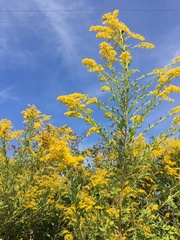 S. altissima
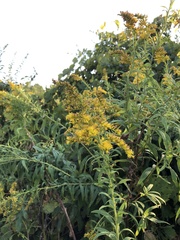 S. canadensis
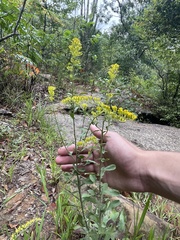 S. nemoralis
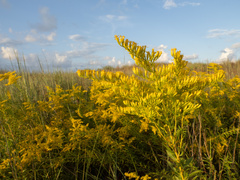 S. odora
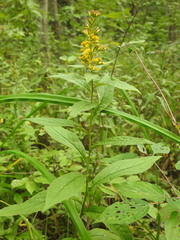 S. rugosa