Gnorimoschema gallaesolidaginis (Riley, 1869)
the elliptical gallA moth. The gall holds a caterpillar, not a maggot
A stretched swelling with a door cut in it before the tenant has any way of opening a door.
A moth, not a fly. The caterpillar tunnels several inches downward from the shoot tip, which is why the resulting gall is elongate rather than round: the damage is a line, not a point.
The life cycle is where popular accounts diverge, and the hosts of the podcast that prompted this guide said so on air before landing on a two-winter version. The literature describes one year. Adults emerge in late summer, mate, and lay eggs in autumn on lower stems and dried leaf litter near the base of the plant. The egg overwinters. Larvae hatch in spring, climb, and bore into the new shoots.15161
Before pupating, the larva cuts an exit passage to the surface, the only stage with chewing mouthparts, and plugs it with silk and plant material. Miller describes the finished plug, or bung, as honey-coloured at first and whitening with weathering, its outer surface flush with a ring of raised plant tissue.15 The opening is bevelled, widening outward, which is easy to push open from inside and awkward to dig into from outside.
Whether the larva leaves a thin membrane over the passage or plugs it completely is reported both ways in popular sources.1
Bung colour is a trait of the moth rather than the plant, and can be used to separate this species from its relatives.15 Miller used it as a marker to ask which goldenrods this moth actually uses, and the answer is narrow: light-bunged galls from Maryland, Michigan and Ohio came off S. canadensis and S. altissima almost without exception. On S. gigantea, S. ulmifolia and S. juncea they are rare.15
Riley named it in 1869, and the name travelled fast: Comstock's Manual for the Study of Insects was using Gelechia gallæsolidaginis as a textbook example by 1895, on the same page as the ball gall and with the same warning that the two are confused.59 The genus has moved twice since. The species name has not moved at all.
Riley gave S. nemoralis as a host in 1869. Miller, who wrote the monograph on this genus, searched for Gnorimoschema galls on that plant and never found one.15 A host record can outlive anyone's ability to reproduce it, so it stays on the page with the doubt attached.
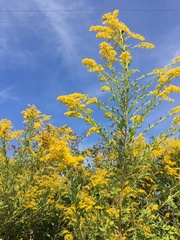 S. altissima
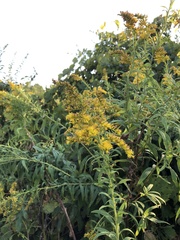 S. canadensis
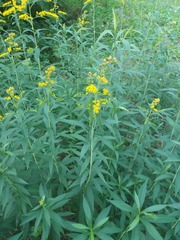 S. gigantea
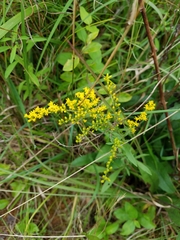 S. juncea
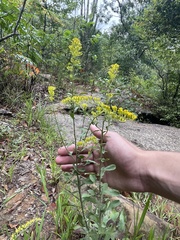 S. nemoralis
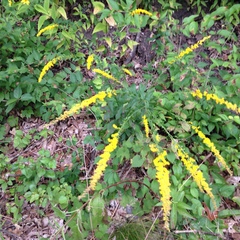 S. ulmifolia