Epiblema scudderiana (Clemens, 1860)
the spindle gallA moth. The gall holds a caterpillar, not a maggot
An elongate stem swelling, holding a caterpillar that spends the winter refusing to freeze, the exact opposite of the ball gall's strategy.
A tapered spindle in the stem, longer than it is wide, occupied by a single tortricid larva.16 It is fusiform, widest at the middle, easing into the stem at both ends rather than sitting on it, and it is easily confused with the elliptical gall of Gnorimoschema. The two are compared on the galls page; the short answer is that this one has no plugged door.
It is a stem gall you are most likely to meet in winter, because that is when the goldenrod is bare and the swelling is obvious, and because the animal inside is then at its most interesting. Nothing about the gall from outside suggests what is going on within it.
The species is univoltine, feeds on no plant but goldenrod, and overwinters as a fifth-instar larva inside the gall.1761 Where Eurosta lets itself freeze and manages the ice, Epiblema refuses. Over one autumn, a natural population's supercooling point fell from −13.9°C to −37.8°C while glycerol rose to 2030 µmol per gram of wet weight, over 2 molar, and 18.7% of the animal's fresh mass.1819 A fifth of the caterpillar, by weight, is antifreeze.
A smaller figure appears elsewhere in the same lab's work and is not a contradiction. Churchill and Storey report peak glycerol at 450–500 µmol per gram, about 4.4%, but that is a laboratory time-course, larvae shifted from +16°C to −4°C and sampled over four days.21 The 18.7% is the midwinter peak of a population living outside through a Canadian winter.18 One is how fast the tap opens; the other is how full the tank gets.
Cryoprotectant production is fast and temperature-cued: in the laboratory, synthesis begins within six hours of a shift from +16°C to −4°C, reaches half-maximal in thirty hours, and peaks after four days.21 Outdoors the trigger is autumn cold reaching about −5°C.20
The switch that starts it is a single enzyme being turned on. Glycogen phosphorylase exists in an inactive and an active form, and cold flips it from one to the other by adding a phosphate group; active enzyme rises from about 0.4 units per gram in early autumn to 7.2 by the November peak. This was among the first demonstrations anywhere that an animal uses reversible phosphorylation to mount a response to environmental stress, a general principle of biochemistry, first seen clearly in a caterpillar inside a weed.19
Glycerol is not the whole defence. The larva also makes antifreeze proteins, sheds total body water, and lines its chamber with a waterproof silk cocoon, all of which keep ice from ever starting. Together these push the temperature at which the animal would freeze from about −14°C in September to −38°C by December, which is below anything its winters are expected to deliver.20
What becomes of the glycerol afterwards is neatly settled. It is not excreted. In spring it is probably burned as fuel for the pupa and the adult, so the antifreeze becomes the flight muscle.20
There is a reason the answer is glycerol specifically, and it is about bookkeeping rather than antifreeze. A larva sealed inside a stem in a frozen field is short of oxygen, and an animal running on fermentation has to keep its redox ledger balanced somehow. Routing carbohydrate the way this one does makes that possible only if large amounts of glycerol come out of the far end. The cryoprotectant is, in part, a by-product of being able to breathe badly for four months.21
Freeze tolerance and freeze avoidance are opposite solutions to the same winter, and both work. The two galls are frequently on the same stem.
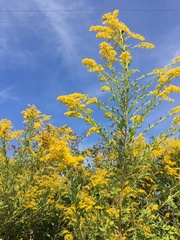 S. altissima
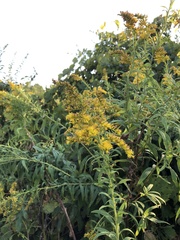 S. canadensis
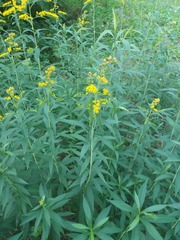 S. gigantea
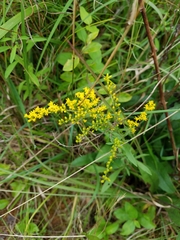 S. juncea
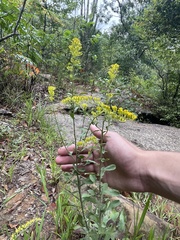 S. nemoralis
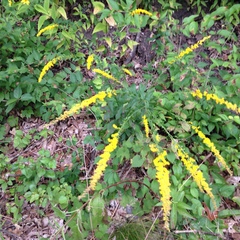 S. ulmifolia